Best Canister Filters for Aquariums (2026)
The best canister filters for aquariums in 2026, with picks for 30 to 250 gallon tanks, plus how to size flow correctly and keep filtration stable.
The best canister filter for most aquariums is the Fluval 207, which pairs quiet, reliable flow with generous media capacity for tanks up to about 45 gallons. Step up to the Fluval 307 for mid-size tanks, or the Fluval FX4 for large freshwater and reef systems. If you want strong filtration on a tight budget, the VEVOR 4-stage and PONDFORSE canisters deliver a lot of flow for the money.
Canister filters are the workhorse of serious fishkeeping. They sit in the cabinet below your tank, pull water through stacked trays of mechanical, biological, and chemical media, and return it polished and oxygenated. Because they hold so much media, they give your beneficial bacteria room to grow, which is the single biggest factor in stable water quality. Below are our researched picks, a quick comparison, and exactly how to match a canister to your tank.
Best Canister Filters at a Glance
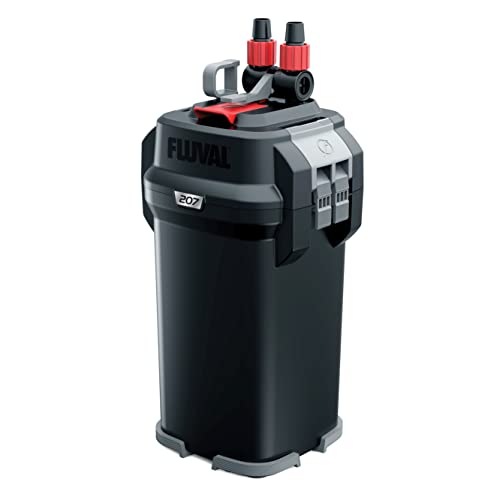
Fluval 207 Performance Canister Filter (up to 45 gal)
$152.99 on Amazon
The sweet-spot Fluval for most planted and community tanks, quiet and easy to prime.

Fluval 107 Performance Canister Filter (up to 30 gal)
$134.99 on Amazon
Compact canister for nano and small community tanks that outgrew a HOB.

Fluval 307 Performance Canister Filter (up to 70 gal)
$189.99 on Amazon
Bigger media baskets and flow for mid-size community and cichlid tanks.

Fluval FX4 High Performance Canister (up to 250 gal)
$309.99 on Amazon
Massive media capacity and self-priming for large freshwater and reef systems.

VEVOR 4-Stage Canister Filter 317 GPH (75-100 gal)
$80.90 on Amazon
High flow and a UV option at a lower price for larger budget builds.

PONDFORSE External Canister Filter with Media
$64.99 on Amazon
An inexpensive starter canister with media included for first-time owners.
Quick comparison
| Filter | Rated tank size | Best for | Approx. price |
|---|---|---|---|
| Fluval 107 | Up to 30 gal | Nano and small community | $134.99 |
| Fluval 207 | Up to 45 gal | Most community and planted tanks | $152.99 |
| Fluval 307 | Up to 70 gal | Mid-size, cichlids | $189.99 |
| Fluval FX4 | Up to 250 gal | Large freshwater and reef | $309.99 |
| VEVOR 4-stage | 75-100 gal | Budget high-flow builds | $80.90 |
| PONDFORSE | Small to mid | First canister on a budget | $64.99 |
Not sure what flow rate you actually need? Plug your tank size into our filter turnover calculator to get a target gph range before you buy.
The picks in detail
Fluval 207: best overall canister filter
The Fluval 207 is the canister we recommend to most keepers building a community or planted tank up to about 45 gallons. It uses a sound-dampened motor and an aqua-stop valve system that makes hose disconnects clean and quick, and the lift-out media baskets are genuinely easy to service. Out of the box it ships with foam, biomedia, and carbon, so you can run it the day it arrives. For the price, the balance of quiet operation, flow, and media room is hard to beat. Pair it with extra biomedia if you keep a heavier bioload, and use the included spray bar to spread current gently across plants.
Fluval 107: best for small tanks
If your nano or small community tank has outgrown a hang-on-back filter, the Fluval 107 is the natural next step. It carries the same quiet motor and easy-prime design as its larger siblings in a compact body sized for tanks up to 30 gallons. Tucking the canister into the cabinet frees up the back glass and gives you cleaner aquascaping lines. It is overkill for a 5-gallon betta tank, but ideal for a 20 to 29 gallon setup where you want canister-grade filtration without a huge unit.
Fluval 307: best for mid-size tanks
The Fluval 307 scales the same proven platform up for tanks to 70 gallons, with larger baskets that hold more biomedia. That extra capacity matters for messier fish like African cichlids or a growing community, where bioload climbs fast. The self-priming feature, instant-on flow, and quiet motor all carry over. If you are torn between the 207 and 307, size up when your stocking plan is ambitious or your fish are heavy waste producers. More media is always easier on your water chemistry than too little.
Fluval FX4: best for big tanks
For large freshwater displays and reef systems, the Fluval FX4 brings serious capacity and convenience. It self-primes at the push of a button, holds a huge volume of media across multiple baskets, and is rated for aquariums up to 250 gallons. The smart pump cycles to purge trapped air automatically, which keeps it running quietly over the long haul. It is an investment, but for a big tank the FX4 means fewer water-quality surprises and far less hands-on fuss. Many owners run one as the backbone of a heavily stocked tank.
VEVOR 4-stage 317 GPH: budget high-flow
The VEVOR canister delivers a lot of flow, around 317 gph, plus a built-in UV option at a price well below premium brands. For keepers building a large tank on a budget, that flow-per-dollar is appealing. You give up some of the refinement and long-term parts support of the Fluval line, so treat it as a strong value pick rather than a lifetime filter. Stock spare gaskets and an impeller, and it can run a big tank reliably for years.
PONDFORSE external canister: budget pick
The PONDFORSE is an inexpensive entry into canister filtration that ships with media included, making it a low-risk way to try a canister on a small or mid-size tank. Flow is adjustable and the unit runs quietly for the price. As with most budget canisters, long-term parts availability is the main caveat, so it suits keepers who want canister benefits without a premium outlay. Keep the foam rinsed and the impeller clean and it will keep your water clear.
How we chose
We did not lab-test these units in our own fish room. Instead, this guide is built from published manufacturer specifications, the established best practices of the hobby, and patterns across large numbers of verified owner reviews. We weighted four things: rated turnover versus real tank volume, total media capacity, noise and ease of priming, and the long-term track record of each brand for parts and reliability.
We favored filters that make it easy to hit a healthy 4 to 10 times turnover per hour at your real water volume, which is usually about 90 percent of the printed tank size once you account for substrate and hardscape. We also gave weight to quiet operation and serviceable media baskets, because a filter you can clean without a fight is a filter you will actually maintain. Prices shift, so always confirm current pricing on Amazon before buying.
Sizing a canister to your tank
- Calculate real volume first. A 40-gallon tank holds closer to 36 gallons of water once decorated.
- Target 4-10x turnover. Light stocking can sit near 4x, while messy or heavy stocking wants 8-10x.
- Round up, not down. A slightly oversized canister gives you media headroom and steadier water.
- Soften flow for plants and bettas. Use a spray bar or aim the return at the glass to reduce current.
For the exact numbers on your setup, run the filter turnover calculator. If you are still planning the tank itself, our stocking calculator helps you match fish to filtration before anything goes wrong.
Aquarium Setup & Maintenance Planner
Stocking planner, water-test log, cycling tracker, maintenance schedule, and more, in one printable planner that keeps your tank on track.
Frequently Asked Questions
What size canister filter do I need?
Match the filter to your real water volume, then aim for 4 to 10 times tank turnover per hour. A 40-gallon tank wants roughly 160 to 400 gph, so a mid-size canister rated for 45 to 70 gallons is a safe choice. Heavily stocked or messy fish like cichlids and goldfish do better at the higher end. Run our filter turnover calculator to get an exact gph target for your tank.
Are canister filters better than HOB filters?
For tanks 40 gallons and up, usually yes. Canisters hold far more media, run quieter, and keep equipment out of sight, which means more stable biological filtration and fewer water-quality swings. The tradeoffs are a higher price and a slightly more involved cleaning routine. On tanks under 30 gallons a quality hang-on-back filter is often the simpler, cheaper choice.
How often should I clean a canister filter?
Most canisters need a rinse every 4 to 8 weeks, or when flow noticeably slows. Rinse mechanical media (sponges and floss) in old tank water, never tap water, so you protect the beneficial bacteria that process ammonia and nitrite. Replace chemical media like carbon on the manufacturer schedule. Avoid deep-cleaning everything at once, since that can stall your cycle.
Can a canister filter run a planted tank?
Yes, and many aquascapers prefer canisters. The closed flow path pairs well with a CO2 reactor or inline diffuser, and a spray bar spreads gentle, even current across plants. Just avoid oversizing flow so much that it blasts delicate stems. For high-tech planted setups, dial flow toward the lower turnover range and watch your plants and fish for signs of too much current.
Do canister filters come with filter media?
Many do, including the Fluval Performance line and several budget models that ship with sponges, biomedia, and carbon. Pre-packed media gets you running on day one, but you can upgrade later with more biomedia for heavier bioloads. Remember that new media holds no beneficial bacteria yet, so a new filter does not skip the nitrogen cycle on a fresh tank.
Why is my canister filter loud or full of air?
Trapped air is the most common cause of noise on a new or freshly cleaned canister. Gently tilt or rock the unit to burp air bubbles toward the outflow, and confirm all hoses and the lid are sealed tight. Persistent rattling usually means the impeller needs cleaning. Most canisters run nearly silent once primed correctly and free of air pockets.
Planning or running a tank?
Use our free calculators and guides to get every number right.
Aquarium Planner: $39