What Is a Protein Skimmer?
A protein skimmer exports dissolved waste from saltwater before it rots. Learn how foam fractionation works, why reefers rely on it, and how to size one.
A protein skimmer is a saltwater filtration device that uses a column of fine air bubbles to lift dissolved organic waste out of the water before it breaks down into ammonia and nitrate. In plain terms, it physically removes gunk from your reef tank instead of waiting for bacteria to process it.
If you are coming from freshwater, the skimmer is the piece of gear with no real equivalent on your old tank. It is often the first major upgrade marine keepers add, because it tackles waste at the source and takes a large load off the rest of your filtration.
How a protein skimmer exports waste
The process is called foam fractionation, and it works on a simple bit of chemistry. Many waste molecules in saltwater are surfactants, meaning one end is attracted to water and the other end is repelled by it. When you fill a chamber with tiny bubbles, those molecules attach to the air-water surface of each bubble.
- A pump drives a dense stream of fine bubbles into a tall reaction chamber.
- Dissolved organic waste sticks to the surface of the rising bubbles.
- The bubbles pile into a thick foam at the top of the chamber.
- That foam climbs into a collection cup and condenses into dark, smelly liquid called skimmate.
- You empty the cup, and the waste leaves your system for good.
This is the key advantage. Your nitrogen cycle converts ammonia to nitrate, but the nitrate still has to be diluted out with water changes. A skimmer instead removes the organic waste before it ever becomes nitrate, so your nutrient levels start lower and stay lower.
Why reef keepers rely on skimmers
Corals are far more sensitive to dissolved nutrients than most fish. High nitrate and phosphate fuel nuisance algae and stress sensitive corals, dulling their color and slowing growth. By exporting waste continuously, a skimmer helps keep those nutrients in the low range corals prefer.
- Lower nitrate and phosphate for healthier, more colorful corals.
- Better oxygenation, since all that bubble contact drives gas exchange.
- Clearer water with a noticeable sparkle, as fine particles are stripped out.
- Less work for your other filtration and fewer giant water changes.
This is why a skimmer is a cornerstone of the saltwater setups we cover in our saltwater aquarium for beginners guide, alongside a sump and quality salt mix.
Why skimmers are a saltwater-only tool
A skimmer needs stable, fine bubbles to function, and only saltwater holds them. The dissolved salts raise surface tension just enough that micro-bubbles persist for several seconds, long enough to collect waste and rise as foam. In freshwater those same bubbles burst almost instantly, so no foam column ever forms. There is no point running a skimmer on a freshwater or planted tank.
Types of protein skimmers
| Type | Where it goes | Best for |
|---|---|---|
| In-sump (internal) | Inside the sump | The standard choice for most reef tanks with a sump |
| Hang-on-back (HOB) | Clipped to display rim | Nano and all-in-one tanks with no sump |
| Nano DC | Sump or AIO chamber | Small reefs that need quiet, low-power skimming |
| External (recirculating) | Beside the sump | Large, heavily stocked systems |
Protein Skimmers by Tank Size

IOAOI Nano Protein Skimmer for Saltwater Aquariums (up to 20 gal)
$79.99 on Amazon
Quiet DC pinwheel pump skimmer sized for nano reefs and AIO tanks.

IOAOI Hang-On Protein Skimmer for Fish Tanks
$99.99 on Amazon
Clip-on HOB skimmer for tanks running without a sump.
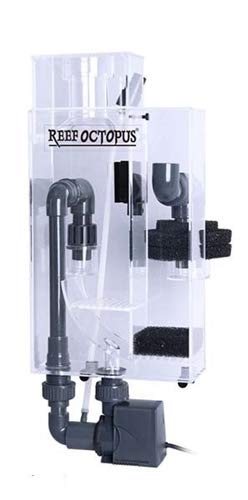
Reef Octopus OCTO Classic BH-2000 Protein Skimmer
$404.24 on Amazon
Workhorse in-sump skimmer for larger, heavily stocked reefs.
Sizing and tuning your skimmer
Size a skimmer to your total system water volume and your bioload, not the display tank alone. Ratings assume a moderate load, so a fish-packed or heavily fed tank should size up a class. An oversized skimmer can be dialed back, but an undersized one will never keep up. For help estimating your real water volume, including sump and rock displacement, use our aquarium volume calculator.
New skimmers go through a break-in period of a week or two where the foam is unstable. Be patient, adjust the water level and air intake slowly, and aim for a steady, dark skimmate. For a deeper comparison of models, see our best protein skimmers roundup.
Where the skimmer fits in your filtration
Think of the skimmer as your first line of defense, working alongside biological filtration rather than replacing it. It pairs naturally with a sump for stable water level and clean operation, and with RODI water and quality salt to keep nutrients low from the start. Get those three working together and your reef becomes dramatically easier to keep stable.
Aquarium Setup & Maintenance Planner
Stocking planner, water-test log, cycling tracker, maintenance schedule, and more, in one printable planner that keeps your tank on track.
Frequently Asked Questions
What does a protein skimmer actually do?
A protein skimmer pulls dissolved organic waste out of saltwater before it breaks down into ammonia and nitrate. It injects a column of fine air bubbles into a reaction chamber, and waste molecules cling to the surface of those bubbles. The foam carries that waste up into a collection cup that you empty. This physically exports gunk from the system rather than just converting it, which keeps nutrients lower and water clearer.
Do I need a protein skimmer for a saltwater tank?
You do not strictly need one, but most reef keepers consider a skimmer the single most valuable filter on a saltwater tank. It removes waste before bacteria turn it into nitrate, which means lower nutrients, better coral health, and more oxygen in the water. Small fish-only nano tanks can get by with frequent water changes instead, but as your bioload and tank size grow, a skimmer makes the system far easier to keep stable.
Why do protein skimmers only work in saltwater?
Skimmers rely on the way saltwater holds tiny, stable bubbles. The dissolved salts and the surface tension of marine water let fine bubbles persist long enough to grab waste and rise as dense foam. Freshwater bubbles pop almost instantly, so the foam never forms and waste is never lifted out. This is why you see skimmers on reef and marine tanks but never on a freshwater planted setup.
How do I size a protein skimmer for my tank?
Match the skimmer to your total system water volume and your bioload, not just the display tank. Manufacturers rate skimmers by gallon range, but those numbers assume a moderate load, so size up if you keep many fish or feed heavily. A lightly stocked 40-gallon reef wants a different skimmer than a fish-packed 40. When in doubt, choose a skimmer rated above your volume, since an oversized skimmer can be dialed back but an undersized one cannot keep up.
Where does a protein skimmer go?
Most skimmers are designed to sit in a sump, the separate tank plumbed below your display, where the water level stays constant. A stable water level matters because skimmers are sensitive to depth. If you do not run a sump, hang-on-back skimmers clip onto the rim of the display tank instead. Either way, place it where you can easily reach the collection cup to empty and clean it.
Planning or running a tank?
Use our free calculators and guides to get every number right.
Aquarium Planner: $39