Aquarium Stocking Calculator
The old rule of thumb is 1 inch of adult fish per gallon, which suits small, slim community fish: a 20-gallon tank holds about 10 two-inch tetras. It breaks down for big or messy fish such as goldfish and cichlids, so add your species below and the calculator weighs adult size, bioload and minimum tank size.
Updated 2026 · free, no sign-up
Keep up with the bioload: good filtration and testing make heavier stocking safer.
Want to keep this result?
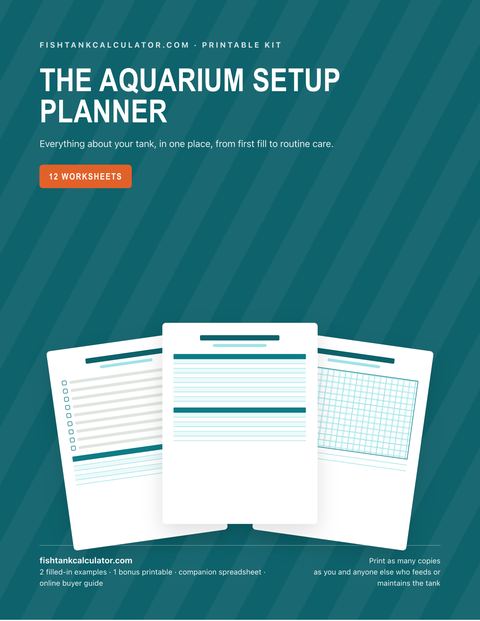
Get it plus the free printable aquarium setup shopping list by email.
Free. No spam. Unsubscribe anytime.
Done. Grab your free printable here:
A Smarter Way to Stock Your Tank
The old inch-per-gallon rule treats every fish the same, but a goldfish and a neon tetra of equal length place wildly different demands on a tank. This calculator weights each species by its real adult size and its bioload, the amount of waste it produces, then checks every fish against its minimum tank size. The result is a stocking level you can actually trust, with warnings when a species needs a bigger tank or a larger group to feel secure.
Rough Starting Points by Tank Size
For small, slim community fish the inch-per-gallon rule gives about 10 two-inch fish for a 20-gallon tank, but treat it as a ceiling to check, not a target.
Inch-per-gallon starting points for small, slim community fish only (adult length). Treat as a ceiling to check, not a target; heavy-bioload fish need far more room.
| Tank | Adult fish inches | Example |
|---|---|---|
| 10 gal | About 10 in | 5 two-inch tetras plus a few shrimp |
| 20 gal | About 20 in | 10 two-inch tetras |
| 29 gal | About 29 in | A school of 8 rasboras plus 6 corydoras |
| 55 gal | About 55 in | Several schools of small community fish |
Filtration and Water Changes Move the Ceiling
Stocking is not fixed. Strong, oversized filtration and consistent weekly water changes let a tank carry more livestock safely, while a weak filter or skipped maintenance lowers the safe ceiling. Treat the percentage here as a planning guide, cycle the tank fully before adding fish, and stock gradually over several weeks.
Plan the rest:
Frequently Asked Questions
How many fish can I put in my tank?
Start with about 1 inch of adult fish per gallon for small community species, then reduce it for fish with a heavy bioload or a large adult size. Every species also has a minimum tank size, which matters more than the inch count. The calculator checks both.
How many fish in a 20 gallon tank?
Roughly 10 small fish such as neon tetras or rasboras, or a smaller school plus a few bottom dwellers. Goldfish and most cichlids need far more room per fish than the inch rule suggests.
How many fish can I put in my tank?
There is no single perfect formula, but a useful starting point is about one inch of slim, adult fish per gallon of real water volume, reduced for heavy-bodied or messy fish like goldfish and cichlids. Just as important is the minimum tank size and swimming room each species needs, plus your filtration and how often you do water changes. This calculator combines adult size, bioload, and minimum tank size to estimate a safe stocking level.
Is the one inch per gallon rule accurate?
It is a rough guide that works best for small, slender community fish in tanks under about 30 gallons. It badly overestimates for large or heavy-bodied fish: a 10-inch goldfish does not belong in a 10-gallon tank. It also ignores swimming space, schooling needs, and territory. Treat it as a sanity check, not a hard rule, and always confirm each species minimum tank size.
What does bioload mean?
Bioload is the total waste your livestock produces, which your filter and water changes have to keep up with. Two fish of the same length can have very different bioloads: a goldfish or pleco produces far more waste than a tetra. A tank that looks understocked by inches can still be overloaded if it holds messy, high-waste fish, which is why this calculator weights each species by its bioload, not just its length.
Can I fully stock a tank right away?
No. A new tank must be cycled first so beneficial bacteria can process ammonia and nitrite, and you should add livestock gradually over several weeks so the filter can keep pace. Adding a full stock at once almost always causes a dangerous ammonia spike. Stock slowly, test your water, and watch for any signs of stress.
Does overstocking actually harm fish?
Yes. Overstocking raises waste levels, lowers oxygen, increases aggression and disease, and stunts growth. Even if water tests look acceptable, crowded fish are more stressed and shorter-lived. When in doubt, understock: a lightly stocked tank is more stable, easier to maintain, and healthier for the fish.